



An Open Tool and Community to Support Earth Decarbonisation
To meet decarbonisation targets, large investments are needed and digital tools are essential to minimise costs for citizens. The open paradigm composed of open data and open-source tools has the potential to break down costs and improve transparent decision-making. In this article, we describe how the open research initiative PyPSA meets Earth is creating a worldwide community that welcomes anybody contributing towards open tools, like PyPSA-Earth, to support the energy transition.
In particular, we describe how the PyPSA-Earth modelling tool is able to identify the least-cost energy mix for the energy system of any country in the world, while meeting environmental targets. A case study of Saudi Arabia shows that PyPSA-Earth could help the country achieve its Vision 2030 goals, reducing emissions by 50% and transitioning away from fossil-fuel-based generation methods. This proves that open energy modelling is state-of-the-art with strong applications in industry and policy decision-making.
By Dhruv Suri, Davide Fioriti, Maximilian Parzen, Stuart Daniel James, Ekaterina Fedotova
At the dawn of the 21st century, renewable energy sources accounted for a mere 18% of global energy demand. Wind and solar, still in their nascent stages, represented only 0.1% and 0.03% of total generation, respectively. Fast forward to 2022, when wind and solar power contributed 4% and 5% of global electricity production, respectively. However, this growth rate falls short of what is needed to truly decarbonise global energy production and establish a net-zero electric power sector. To achieve this ambitious goal, we must harness the vast potential of other global resources, particularly onshore and offshore wind, whose total potential exceeds 40 times the global electricity consumption, according to estimates by the International Renewable Energy Agency, and which is therefore emerging as a highly suitable option for driving the energy transition.
Reaching global decarbonisation targets requires countries and industry to proactively determine the required investments needed to meet the burgeoning demand for electricity. This planning process must account for the time required to implement new capacity installations, restructure industries to meet the accelerated demand for production, and maintain a delicate balance between society, the economy and natural resources. It encompasses a wide array of fields, perspectives and ideas, while also acknowledging the inherent uncertainty that characterises each of these ecosystems. To address these challenges, accelerate the adoption of renewables and equip decision makers with the necessary resources, digital tools are critical. These tools play a key role in representing the global energy system, identifying key technologies, planning infrastructure investments and prioritising areas of action – all while making tangible progress towards our decarbonisation goals. Achieving these global targets requires a combination of regional decisions and conditions unique to each country. Such planning tools can refine and coordinate optimisation efforts. And so, the impetus should not only be on meeting global energy demand but also on ensuring universal access to reliable electricity. Open data and open-source tools are indispensable for planning, optimisation and the widespread deployment of resources at a global scale.
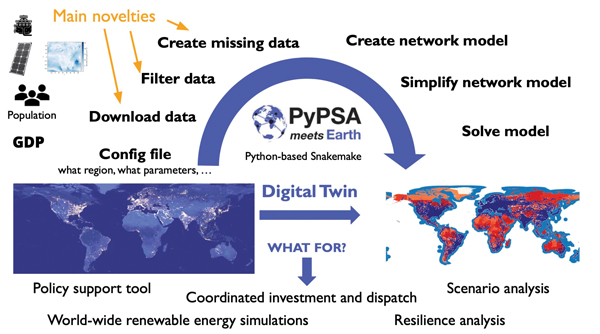
 PyPSA meets Earth is an independent research initiative that aims to improve energy system planning with a focus on community-sourced platform development and open-source solutions applied at a global scale. The initiative’s vision is to support transparent and debatable decision-making by developing open solutions as an alternative to commercial ‘black-box’ tools, which are the current standard de facto. PyPSA-Earth, an open-source tool for energy system modelling, is one such powerful resource that facilitates this endeavour. The tool combines economic optimisation with a realistic representation of power flows in regional power transmission grids, while considering the dynamics of wind and solar potential (Fig. 1). Accounting for operational constraints is crucial to designing power systems capable of accommodating an increasing share of intermittent generation from renewables, even more so from wind.
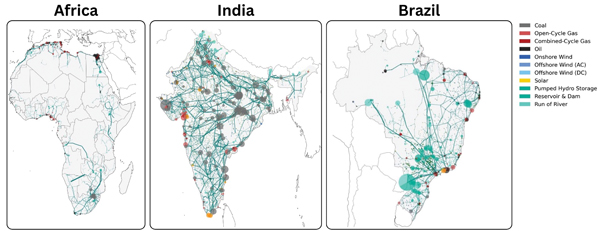
PyPSA-Earth, through its utilisation of high-resolution data from multiple sources at various levels of spatial and temporal granularity, constructs a comprehensive model of a region’s power system. This model ensures credibility by incorporating a data extraction method and a quality assessment metric that relies exclusively on globally available open data. Consequently, an energy system model is developed, accounting for technological, economic and infrastructure constraints in any country worldwide. By analysing historical trends, socio-economic indicators and future population projections, the model approximates global energy demand by country and formulates an optimal mix of energy generation sources capable of meeting this demand in any subregion of the world. The power system modelling approach offers a significant advantage by allowing iterative testing of different generation mix configurations while optimising for cost and carbon emissions reduction. This enables the investigation of possible pathways to a net-zero future for a specific region, considering regional heterogeneity and local factors. The model’s applicability has been validated through several case studies conducted in different parts of the world (Fig. 2).
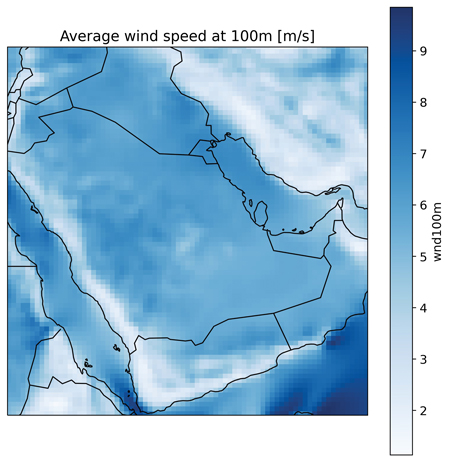
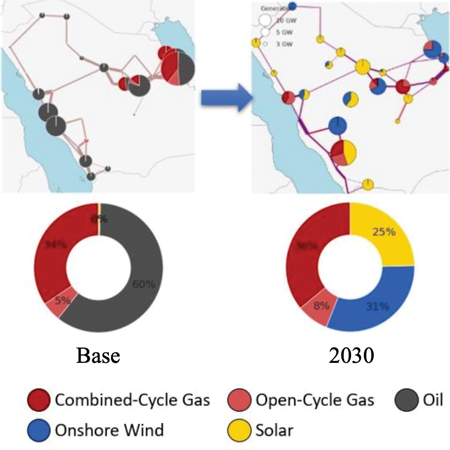 One such study assessed the integration of renewable energy in fossil-fuel-dependent Saudi Arabia. Despite the country’s substantial wind generation potential (Fig. 3), including 37GWh of annual generation potential from offshore wind installations alone, the dominance of thermal generation persists due to the deep-rooted reliance on oil and gas engrained in the country’s economy. Saudi Arabia’s Vision 2030 goals target 16GW of installed wind capacity; however, achieving this target is challenging given the current rate of development and the absence of optimal implementation pathways. PyPSA-Earth demonstrated an opportunity to reduce 50% of present-day emissions to meet its 2030 goals by unfolding the country’s wind and solar generation potential. It has been found that the optimal generation mix has a significant amount of wind power in the 2030 scenario (Fig. 4). Accommodation of renewable generation requires adjustments in power transmission infrastructure, in particular in central and southwest areas, while there is still no need for costly power storage solutions. Solar power is generated at daylight hours, with wind being the main power source during nights, and thermal power is used to cover demand peaks.
The optimisation of Saudi Arabia’s power generation mix illustrates that tools like PyPSA-Earth can be applied not only to economies with a moderate reliance on fossil fuels but also to those where thermal generation constitutes a significant portion of the current grid mix. Maximising wind energy production and swiftly deploying necessary infrastructure are crucial steps towards achieving global climate targets. Power systems modelling, exemplified by tools like PyPSA-Earth, empowers us to make informed decisions by quantifying the trade-offs between costs, emissions reduction and the scalability of renewable energy. Embracing this approach enables us to navigate the complex energy landscape and accelerate the transition towards a sustainable and resilient future. The time to unlock the full potential of wind energy is now, and by doing so we can pave the way for a greener, cleaner world for generations to come.
Further Reading
- Algarei, A. 2022. Planning Saudi Arabia’s Energy Transition for 2060 with PyPSA. MSc Dissertation Thesis. The University of Edinburgh. https://doi.org/10.5281/zenodo.7017741
- Hörsch, J., Hofmann, F., Schlachtberger, D. and Brown, T. 2018. PyPSA-Eur: An open optimisation model of the European transmission system. Energy Strategy Reviews 22, 207–215.
- Parzen, M. 15 power systems around the world. https://forum.openmod.org/t/15-power-systems-around-the-world/3528
- Parzen, M., Abdel-Khalek, H., Fedotova, E., Mahmood, M. et al. 2023. PyPSA-Earth. A new global open energy system optimization model demonstrated in Africa. Applied Energy 341, 121096.
- PyPSA meets Earth initiative: https://pypsa-meets-earth.github.io/projects.html